

Early American Pattern Glass: Investing in Everyday Elegance

Part 1: The Opportunity – Why Early American Pattern Glass, Why Now?
Open the doors of an old corner cupboard and you might find them: pressed glass goblets with tiny stars, covered compotes with thumbprint patterns, oil lamps with crisp geometric designs. For decades, these pieces were treated as “grandma’s glass” or box-lot filler at country auctions.
But look closer, and you’ll see something else:
- Remarkable craftsmanship for a mass-market product
- Deep American industrial history
- A category where quality often far exceeds price
That’s the opportunity in Early American Pattern Glass (EAPG).
You’re not just buying glassware. You’re buying the story of America’s 19th-century table, at price points that remain surprisingly accessible.

Early American pressed glass EAPG large clear bullseye pattern covered compote candy dish along with two other compoted pedestal bowls; 3pc group. 12″H x 8″W (covered)
photo: ripleyauctions.com
What Is Early American Pattern Glass?
For this guide, we’re focusing on:
- Timeframe: Roughly 1850–1910
- Production: Pressed glass made in molds, produced in patterns and sets
- Use: Everyday tableware—goblets, compotes, pitchers, sugars, creams, celery vases, cake stands, etc.
- Defining feature: Repeating patterns (geometric, floral, figural, commemorative) that give each line its identity
EAPG sits between flint glass and later Depression glass, bridging the gap between early hand-made tableware and fully industrial 20th-century production.
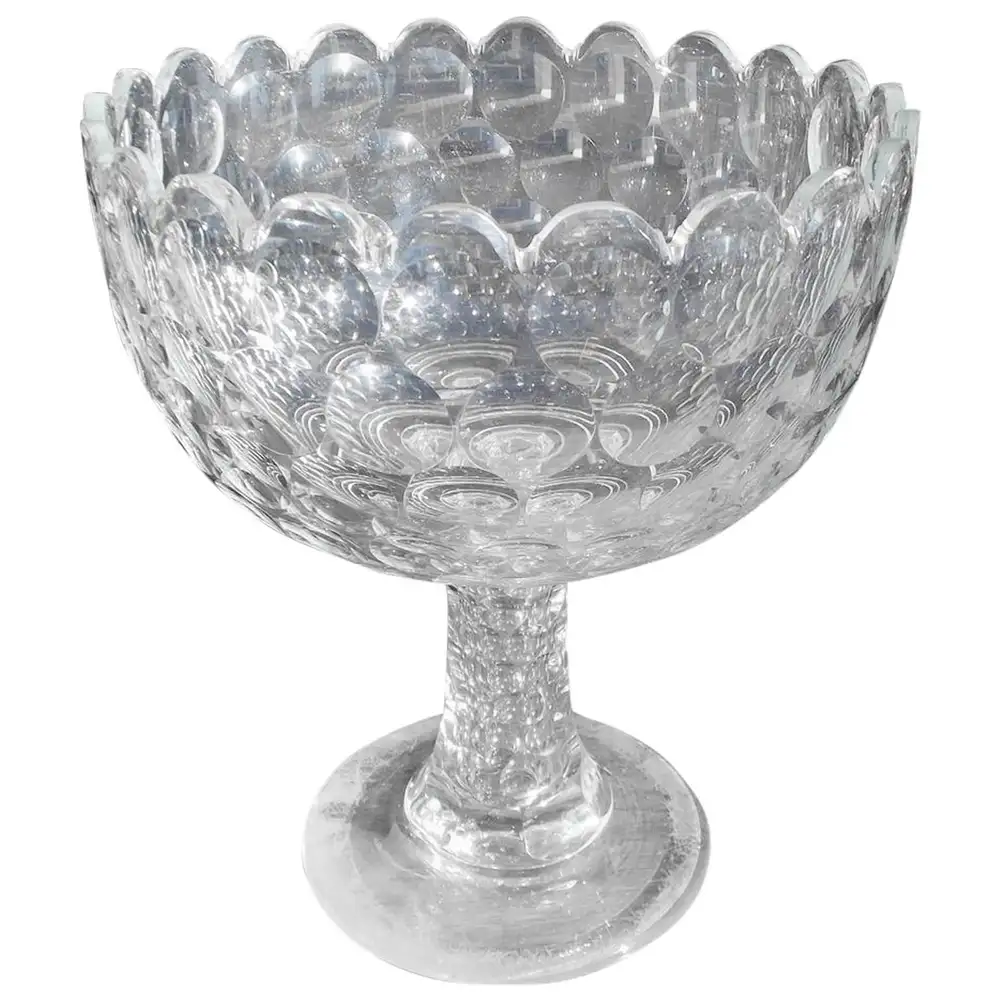
Early American glass pattern bowl with a scalloped exterior edge, recessed circular motif and terminating on a tapered recessed circular stem with a beveled transparent base, Early 19th
century. Bowl is 10” diameter at top and 6” diameter at base.
photo: 1stdibs.com
Market Snapshot
While some high-profile antiques categories have softened or plateaued, EAPG offers:
- Entry points:
- $25–$75 for common patterns and forms in good condition
- $75–$250 for scarcer patterns, colored pieces, and desirable forms
- $250+ for rare patterns, unusual colors, and top-tier forms (covered compotes, large pitchers, figural pieces)
- Appreciation potential:
- Modest but steady in documented rare patterns and colors
- Stronger movement in cross-over pieces (e.g., colored glass, figural motifs, and forms that appeal to decorators)
- Demand drivers:
- Renewed interest in “setting the table” and home entertaining
- Collectors priced out of high-end art glass looking for earlier, documented American glass
- Cross-over appeal to decorators who want sparkle and pattern on sideboards and in cupboards
EAPG is not a “rocket ship” category—but that’s exactly why it’s interesting for strategic collectors. It’s undervalued relative to its age, craftsmanship, and historical importance, with room for selective appreciation.
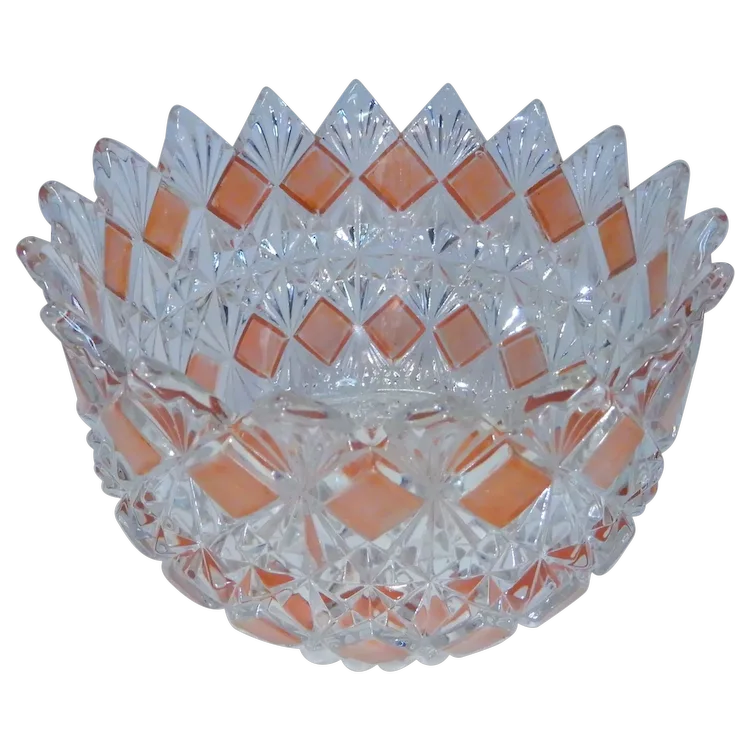
Antique Early American Pattern Glass bowl in clear and coral. It features fans and diamond shapes. The edges are pointed. The bowl is very similar to George Duncan and Sons Pattern No. 33 Also known as “block” which was
introduced in1889 and produced from 1889 through 1891. The pattern features prominent square blocks that created a bold geometric look.
photo: rubylane.com
Why Now?
- Generational Turnover
Collections built in the mid-20th century are coming back to market as estates are settled. That means supply and choice—and opportunities to cherry-pick the best pieces. - Shift Toward Authentic, Everyday History
Collectors and decorators are increasingly drawn to objects that feel lived-in and real. EAPG is the glass of Sunday dinners, church socials, and holiday tables—not just formal parlors. - Documentation & Scholarship
EAPG is one of the better-documented American glass categories, with pattern books, reference guides, and active collector organizations. That makes it easier to learn and buy intelligently. - Undervalued Relative to Art Glass
While certain art glass lines command four and five figures, you can still buy 19th-century American glass with strong patterns and presence for under $200.
For collectors who appreciate design, history, and the ritual of the table, EAPG offers a way to build a meaningful collection without needing a museum budget.
Part 2: The Category Deep Dive
To collect Early American Pattern Glass intelligently, you need to understand its main components.
Key Forms
- Goblets & Tumblers
The backbone of many collections; patterns are often easiest to learn on goblets. - Compotes & Footed Bowls
Covered and uncovered; strong display pieces with good presence. - Pitchers & Creamers
Water, lemonade, and syrup pitchers; often show the pattern particularly well. - Sugars & Covered Dishes
Lidded forms are more fragile and often harder to find intact. - Cake Stands & Pedestals
Highly decorative and popular with decorators and bakers. - Celery Vases & Spooners
Distinctive vertical forms that read well in a cupboard or on a sideboard. - Oil Lamps & Specialty Forms
Cross-over appeal with lighting and Victorian decorative arts.
Patterns & Motifs
EAPG patterns are often named and cataloged. Common motifs include:
- Geometric: Diamonds, stars, fans, hobnails, and panels.
- Floral & Naturalistic: Leaves, vines, flowers, fruit.
- Figural & Novelty: Animals, people, objects (e.g., “Thousand Eye,” “Daisy and Button,” “Log Cabin”).
- Commemorative: Patterns celebrating events, political figures, or organizations.
Collectors often specialize by:
- Pattern (one or several named patterns)
- Motif (e.g., all patterns with stars, all with fruit, all with animals)
- Form (e.g., only goblets, only cake stands)
What Drives Value in EAPG
- Pattern Rarity & Popularity
Some patterns were produced in large quantities; others were short-run or limited to specific makers. Rarity plus strong design equals opportunity. - Form
Common forms (goblets, small bowls) are more accessible. Scarcer forms (large pitchers, covered compotes, cake stands, unusual serving pieces) often command higher prices. - Color
While clear glass dominates, colored EAPG—amber, amethyst, blue, canary/vaseline, and opaque colors—can be significantly more desirable. - Condition
Chips, cracks, and cloudiness (sick glass) matter. Rim chips and base nicks are common; severity and visibility affect value. - Provenance & Documentation
Identified patterns, known makers, and references in standard guides support value and collector interest.
Part 3: Collecting Strategy – How to Build a Smart EAPG Collection
You don’t need to fill a whole cupboard overnight. You do need a thoughtful approach.
Step 1: Choose Your Focus
Consider one (or a combination) of these lanes:
- Pattern-Focused
Build out one or a few named patterns across multiple forms. - Form-Focused
- Only goblets (a classic approach)
- Only cake stands and compotes
- Only pitchers and large serving pieces
- Color-Focused
- All clear with strong pattern definition
- Only colored EAPG (amber, blue, amethyst, vaseline, opaque)
- Theme-Focused
- Star and geometric motifs
- Floral and fruit patterns
- Commemorative and figural designs
A focused collection is easier to research, display, and eventually present as a cohesive whole.
Step 2: Train Your Eye for Quality
When you pick up a piece of EAPG, ask:
- Pattern Clarity:
- Are the details crisp, or soft and worn?
- Does light catch the pattern cleanly?
- Form & Proportion:
- Does the piece sit flat and feel balanced?
- Are the stem and foot well-formed (for goblets and compotes)?
- Condition:
- Check rims, handles, and finials for chips.
- Look for cracks by holding the piece up to light.
- Check for cloudiness or residue that may not clean out.
- Color (if applicable):
- Is the color even and attractive?
- Does it glow under UV light (for vaseline/uranium glass)?
Step 3: Where to Find Opportunity
- Country Auctions & Estate Sales
EAPG often appears in box lots or mixed glassware groups. Knowledgeable buyers can pull out the best pieces. - Regional Antiques Shops & Malls
Many dealers still price EAPG modestly, especially if their focus is furniture or broader decorative arts. - Glass Shows & Club Events
Specialized shows offer depth and education; prices may be higher, but so is the quality.
Step 4: Common Mistakes to Avoid
- Confusing EAPG with Later Glass
Learn to distinguish EAPG from Depression glass and modern pressed glass. Age, pattern, and mold quality are clues. - Ignoring Condition
A pattern may be rare, but heavy chips, cracks, or sick glass can permanently limit desirability. - Buying Only on Price
Cheap but common, damaged pieces will always be cheap. It’s often better to buy fewer, better examples. - Overcleaning or Abrasive Cleaning
Harsh scrubbing can scratch glass. Use gentle methods and avoid anything that might frost the surface.
Part 4: 90-Day Action Plan
Month 1: Learn the Landscape
Goal: Understand the basics before you buy.
- Pick your focus: pattern, form, color, or theme.
- Acquire or borrow a standard reference on EAPG (pattern books, identification guides).
- Study 3–5 patterns that interest you: note their forms, typical prices, and known makers.
- Visit at least one local shop or show and look only at EAPG (or suspected EAPG).
- Note 10–15 pieces: form, pattern (if known), price, and condition.
You’re building a mental catalog of what’s common, what’s scarce, and how condition affects price.
Month 2: Meet the Market
Goal: Handle real pieces and talk to people who know the glass.
- Research and locate dealers who specialize in glass or tableware.
- Visit or contact at least one.
- Visit or contact at least one.
- Handle as many pieces as possible (with permission):
- Feel weight and thickness.
- Compare pattern sharpness across pieces.
- Examine rims and bases for typical wear.
- Ask dealers three questions:
- “Which patterns or forms are selling best right now?”
- “Where do you see value under $150–$200?”
- “What would you avoid as a new EAPG buyer?”
- If possible, attend a glass show or club meeting.
- Listen to how experienced collectors talk about patterns, makers, and condition.
You’re gathering practical knowledge that goes beyond pictures in a book.
Month 3: Make Your First Strategic Purchase
Goal: Acquire one piece that fits your focus and teaches you something.
- Set a clear budget (for example, $75–$200).
- Identify 2–3 candidate pieces that align with your chosen lane.
For each candidate, evaluate:
- Pattern & Form:
- Is this a strong example of the pattern?
- Is the form desirable (e.g., compote, pitcher, cake stand vs. very common forms)?
- Condition:
- Are chips minor and in unobtrusive areas, or major and distracting?
- Any cracks or serious damage?
- Price vs. Market:
- Compare with at least three similar examples (dealer stock, show prices, or auction results).
Before you commit:
- Ask about history: Where did it come from? Has it been in a collection for a long time?
- Decide with both your eye and your head: Does it fit your focus? Does it “spark joy” when you hold it?
Once you buy:
- Document the piece:
- Photos (overall and detail shots)
- Measurements
- Condition notes
- Purchase price, date, and source
- Pattern name and maker (if known)
- Display it thoughtfully:
- In a cupboard, on a sideboard, or as part of a table setting.
- Avoid unstable surfaces and direct, harsh sunlight.
- Reflect on the purchase:
- What did you learn about pattern, form, and condition?
- What would you look for next time?
Part 5: Beyond 90 Days – Building a Cohesive EAPG Collection
- Add a few carefully chosen pieces per year rather than buying in bulk.
- As your knowledge grows, don’t be afraid to trade up—selling or consigning lesser pieces to fund better examples.
- Keep a simple log of patterns, forms, prices, and sources; over time, it becomes your personal EAPG reference.
Final Thought
Early American Pattern Glass is not a hype-driven category. That’s its strength.
It offers:
- Authentic 19th-century American history
- Documented patterns and makers
- Accessible price points
- Room for selective appreciation in rare patterns, forms, and colors
Handled thoughtfully, EAPG lets you build a collection that sparkles on the table, tells a story in the cupboard, and quietly rewards the patient, informed collector.
That’s the heart of Investment Intelligence: collections you live with and love, built with knowledge and intention.

Sponsored


