

Vintage Music Memorabilia: Investing in Sound, Story, and Stardom
“Investment Intelligence” is the Journal of Antiques & Collectibles’ quarterly guide to strategic collecting.
In each issue, we spotlight one antiques or collectibles category that shows:
- Documented price growth over multiple years
- Accessible entry points (often starting around $200)
- Strong fundamentals (scarcity, museum interest, active buyers)
This isn’t hype. It’s data-informed collecting backed by market research, dealer insights, and 25 years of editorial experience.
What You’ll Find in Each Guide
- Market snapshot: Why this category, why now
- Key makers, artists, or subcategories to watch
- Authentication and condition basics
- Where to buy: shows, dealers, and regional strategies
- A practical 90-day action plan to start or refine your collection
How to Read This Series
- Magazine Subscribers ($39.99/year)
Get each Investment Intelligence guide serialized over three issues of the Journal—perfect if you like to absorb information gradually and follow along month by month. - Full Access Members ($64.99/year)
Get the entire guide at once, plus all magazine benefits, expert advice, DIY tutorials, restoration tips, and vintage lifestyle content—ideal if you want to move quickly on emerging opportunities.
A Note of Caution
Investment Intelligence is designed to inform your collecting, not guarantee financial returns. Markets move, trends shift, and every purchase still requires your own research, due diligence, and expert consultation when needed.
Have a Category in Mind?
We are building this series with our community. Send your ideas, questions, or collecting stories to editor@joac.online and tell us which category you’d like to see featured next.
A first-year-of-release movie poster for The Beatles’ film Let It Be.
United Artists, UK Quad film poster, Linen backed, This work is presented unframed.
The poignant Beatles’ documentary Let It Be which was filmed within the last 4 weeks before the iconic band broke up.
Dimensions: Height: 30 inches,
Width: 40 inches

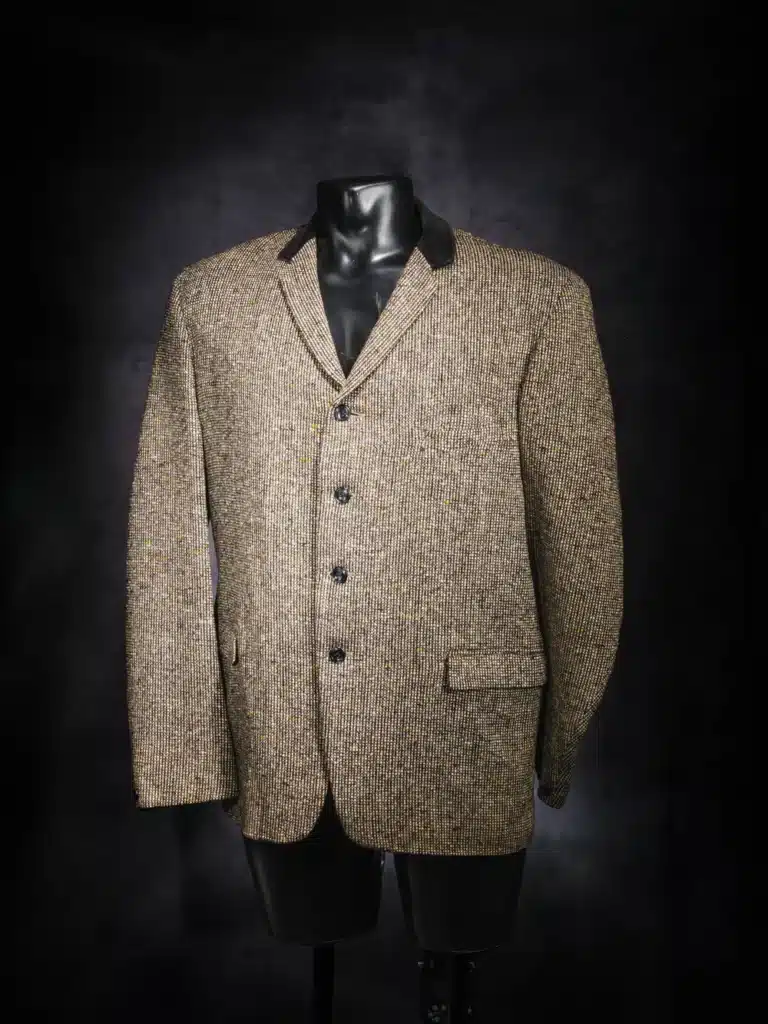
Very rare and sought after Mick Jagger worn tweed jacket.
Jagger wore this jacket in the Rolling Stones film Rewind.
Stylist Roger Burton supplied this tweed jacket to Jagger.
This piece is accompanied by a signed letter from Burton and also a photo of Jagger wearing it.
Part 1: The Opportunity – Why Vintage Music Memorabilia, Why Now?
A signed LP tucked behind the counter. A concert poster from a 1972 tour. A stage-used setlist taped to the back of a speaker. These pieces don’t just recall a song—they capture a moment: a night, a tour, an era.
Vintage music memorabilia sits at the intersection of Pop culture history, visual design, and deep personal nostalgia
And right now, it’s one of the most emotionally charged—and increasingly competitive—collecting categories.
You’re not just buying paper or vinyl. You’re buying a direct link to the artists and performances that shaped people’s lives.
Market Snapshot
Across auction houses, specialist dealers, and private sales, key segments of music memorabilia show:
- Estimated appreciation:
10–20% annually for top-tier artists and scarce pieces
Strong upward movement in certain genres (punk, early hip-hop, grunge, 90s alt-rock) - Entry points:
Under $200 for vintage tour programs, unsigned posters, and common promo items
$300–$1,000 for desirable original posters, ticket stubs, and signed items from well-known acts
$1,500+ for rare posters, stage-used items, and high-demand autographs - Demand drivers:
Multiple generations of fans (Boomers through Gen Z) collecting the same artists
Documentaries, biopics, and reunion tours reigniting interest
Cross-over with interior design (framed posters, records, and instruments as decor)
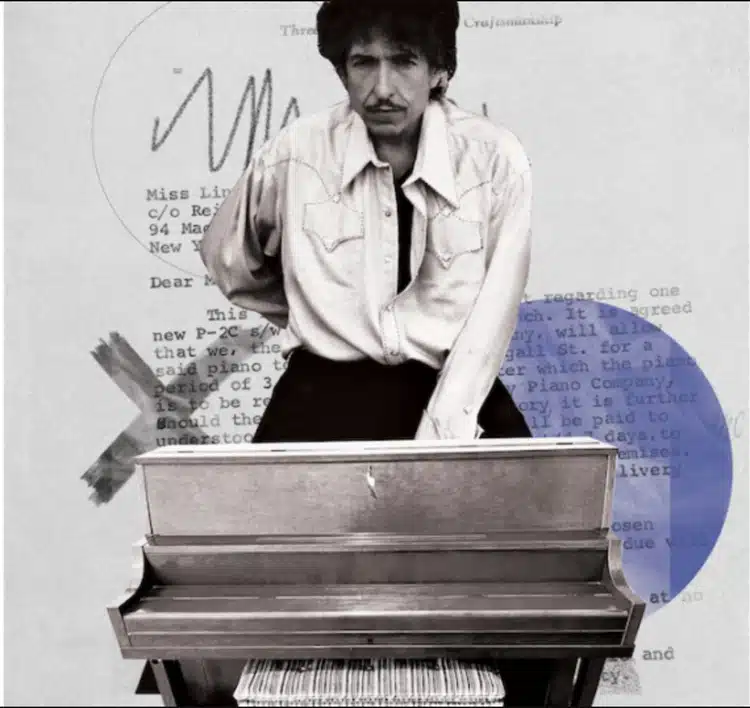
One of the most important Bob Dylan finds of the last century; Dylan’s personally-owned and used Yamaha upright piano. Owned by Dylan from September 1969 to circa 1975. In this time period Dylan wrote 5 albums including one of his most revered, Blood on the Tracks which includes one of his most important songs ‘Tangled up in blue”.
Why Now?
- Aging Legends, Finite Supply
Many of the artists who defined rock, soul, and early pop are aging—or gone. No new “vintage” tours from the 1960s and 70s will ever be created. What exists is all there is. - Streaming Era Backlash
As music becomes intangible (streams, playlists, algorithms), fans and collectors are seeking physical artifacts that feel real and permanent. - Crossover with Fine Art and Design
Original concert posters, especially from the psychedelic, punk, and indie eras, are increasingly treated as graphic art—framed and displayed like prints. - New Generations Discovering Old Icons
Biopics, documentaries, and social media are introducing younger listeners to artists decades after their prime. That creates fresh demand for vintage material.
For collectors who love both music and material culture, this is a category where a $300–$800 purchase can still secure a historically meaningful piece—especially if you look beyond the most obvious names.
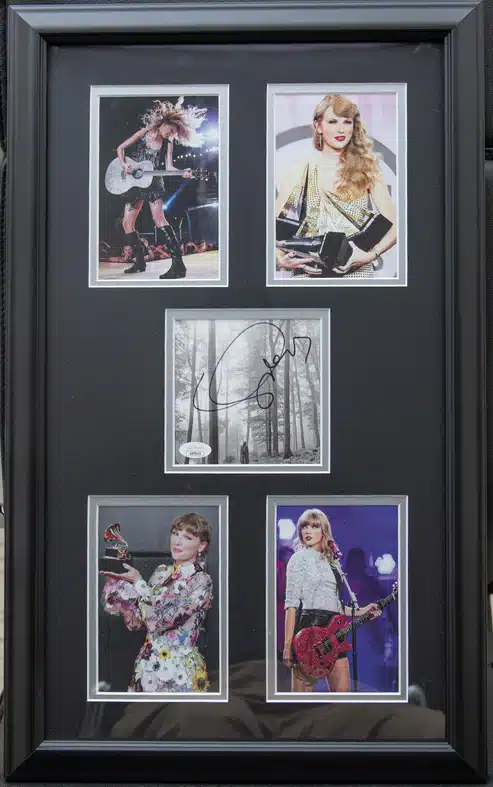
Taylor Swift Signed Collage
Part 2: The Category Deep Dive
“Vintage music memorabilia” is broad. To collect intelligently, you need to understand the main formats and what drives value.
Key Formats
1. Concert Posters & Handbills
- Original venue posters, tour posters, and handbills
- Value drivers: artist, venue, date, design, printer, and condition
- Psychedelic 1960s, early punk, and regional scenes are especially strong
2. Ticket Stubs & Programs
- Physical evidence of attendance at specific shows
- High value for historic performances (early tours, final shows, legendary festivals)
- Programs with photos and essays add depth and display value
3. Signed Items (Autographs)
- Signed LPs, photos, posters, instruments, and setlists
- Authenticity and provenance are critical; third-party certification often matters at higher price points
4. Stage-Used & Tour-Used Items
- Setlists, drumsticks, guitar picks, clothing, backline labels, road cases
- Strong emotional pull, especially when tied to specific performances or tours
5. Promotional Materials
- Record company promo photos, press kits, in-store displays, and flats
- Often overlooked but can be scarce and visually strong
6. Instruments & Gear
- High-end, artist-associated instruments are a separate, advanced category
- For this guide, we’ll focus mostly on paper and small objects accessible under $1,000.
What Drives Value in Music Memorabilia
1. Artist & Era
- Top-tier names (Beatles, Stones, Dylan, Hendrix, Zeppelin, Bowie, etc.) lead the market
- Growing strength in punk, early metal, grunge, 80s/90s pop, and early hip-hop
2. Historical Significance
- First tours, breakthrough albums, final shows, legendary venues (Fillmore, CBGB, etc.)
- Items tied to specific, documented events carry a premium
3. Scarcity & Survival
- Many posters and handbills were stapled to poles or taped to walls—few survived in good condition
- Ticket stubs were often discarded; complete, legible examples are desirable
4. Condition
- For paper: folds, tears, stains, fading, pinholes, trimming
- For signed items: smudging, fading, and whether the signature is on a strong image or desirable object
5. Authenticity & Provenance
- Known printers, venues, and designers (e.g., Bill Graham, Family Dog, Hatch Show Print)
- Third-party authentication for autographs and high-value items
- Clear chain of ownership or first-hand acquisition stories
Part 3: Collecting Strategy – How to Build a Smart Music Memorabilia Collection
You don’t need a vault or a rock-star budget to collect intelligently in this category. You do need a plan.
Step 1: Choose Your Lane
Consider focusing on one (or two) of these:
- Artist-Focused: One band or artist across formats (posters, tickets, programs, signed items).
- Genre or Era-Focused: British Invasion, 60s/70s rock, Punk and new wave, 80s/90s alternative, Early hip-hop
- Venue or Scene-Focused: Memorabilia from a specific club, city, or regional scene (e.g., New York punk, San Francisco psych, Nashville country, Athens, GA alt-rock).
- Format-Focused: Only posters, Only ticket stubs and programs, Only signed LPs
A focused collection is easier to research, display, and eventually present to future buyers or institutions.
Step 2: Train Your Eye (and Ear) for Quality
When evaluating a piece, ask:
1. Is the moment important?
- Early tours, album-release shows, festival appearances, and “last tours” are stronger than generic dates.
2. Is the design compelling?
- For posters: typography, color, imagery, and layout matter.
- For signed items: is the signature placed well and clearly visible?
3. Is the condition honest and original?
- Typical wear (folds, pinholes) is acceptable at the right price.
- Heavy restoration, trimming, or bleaching can hurt long-term value.
4. Can the story be told?
- “This was the first US tour.”
- “This show was recorded for a live album.”
- “This venue no longer exists.”
Collectors and future buyers pay for story as much as for ink and paper.
Part 4: Where to Find Undervalued Pieces of Vintage Music Memorabilia
- Record Stores & Local Shops
Some still have vintage posters, in-store displays, and promo items tucked away. - Regional Antiques Shows & Flea Markets
Ticket stubs, programs, and posters often appear mixed with paper ephemera. - Estate Sales
Look for homes with large record collections, band t-shirts, and music books—signs of a serious fan. - Specialized Dealers
Dealers who focus on posters, paper ephemera, or pop culture often handle music material. - Auctions (Local & Specialist)
Smaller regional auctions may have less competition for music lots, especially outside the biggest names.
Part 5: Common Mistakes to Avoid
- Buying Reproductions as Originals
Many classic posters have later reprints. Learn the tells: paper type, printer marks, size, and known edition differences. - Ignoring Authentication for Autographs
High-value signatures without credible provenance or third-party certification can be risky. - Overlooking Condition
A rare poster with heavy fading or major restoration may always be a compromise piece. - Chasing Only the Biggest Names
While top-tier artists are important, there is strong opportunity in scene-based collecting—post-punk, early indie, regional country, early hip-hop—where prices haven’t fully caught up.
Part 6: 90-Day Action Plan
Month 1: Learn the Landscape
Goal: Understand what’s out there before you buy.
- Pick your lane: artist, era, venue/scene, or format.
- Study 2–3 auction catalogs or online archives focused on music memorabilia.
- Note hammer prices, not just estimates.
- Pay attention to condition notes and provenance.
- Visit at least one local shop (record store, antiques shop, or vintage store) and look only at music-related items for 15–20 minutes.
- Note 5–10 pieces: artist, format, date (if known), price, and condition.
You’re building a mental price and rarity map.
Month 2: Meet the Market
Goal: Handle real pieces and talk to people who live in this category.
- Visit or contact at least one shop that carries vintage music memorabilia.
- Handle as many items as possible (with permission): posters, programs, ticket stubs, signed LPs.
- Look closely at paper quality, printing, signatures, and wear.
- Ask dealers three questions:
- “What’s selling fastest right now?”
- “Where do you still see value under $1,000?”
- “What would you avoid as a new collector?”
- If possible, attend a record fair or music-focused show.
- Compare pricing and condition across multiple sellers.
You’re gathering real-world intelligence that doesn’t show up in price guides.
Month 3: Make Your First Strategic Purchase
Goal: Acquire one piece that fits your lane and teaches you something.
- Set a clear budget (for example, $300–$800).
- Identify 2–3 candidate pieces that fit your chosen focus.
For each candidate, evaluate:
- Historical significance: Is this tied to an important tour, venue, or era?
- Condition: Are flaws acceptable at the price? Is there restoration?
- Authenticity:
- For posters: does it match known originals in size, printer, and paper?
- For autographs: is there credible provenance or certification?
Before you commit:
- Compare with at least three similar items (auction results, dealer listings, or show prices).
- Ask about history: Where did it come from? How long has the seller had it?
Once you buy:
- Document the piece:
- Photos (front, back, details)
- Measurements
- Condition notes
- Purchase price, date, and source
- Any provenance or stories attached
- Store or display it properly:
- Use acid-free materials and UV-protective framing for paper.
- Avoid direct sunlight and high humidity.
- Reflect on the purchase:
- What did you learn?
- What would you look for next time?
Part 7: Beyond 90 Days – Building a Cohesive Music Memorabilia Collection
- Add 1–3 pieces per year in your chosen lane.
- As your knowledge grows, don’t be afraid to trade up—selling a lesser piece to fund a stronger one.
- Keep a simple log of auction results, dealer conversations, and new finds; over time, it becomes your personal market guide.
Sponsored


