
Studio Pottery Investment Guide: How $200 Ceramics Outperform Stocks

Welcome to “Investment Intelligence,” a quarterly series from Journal of Antiques & Collectibles exploring emerging categories with exceptional appreciation potential. In this inaugural edition, we examine studio art pottery from the 1960s-1980s—a market segment experiencing dramatic revaluation as collectors discover museum-quality pieces still available at accessible prices.


When a $75 Bowl Becomes a $1,200 Treasure
Last spring, a Massachusetts collector purchased an unassuming ceramic bowl at a New Hampshire estate sale for $75. The piece bore a simple impressed mark on the bottom—two initials she didn’t immediately recognize. After researching the signature, she discovered she’d acquired a rare early work by Toshiko Takaezu, one of the studio pottery movement’s most influential artists. Three months later, that bowl sold at auction for $1,240.
This isn’t an isolated incident. Across the country, studio pottery from the 1960s through 1980s is experiencing a market correction that savvy collectors are calling the best investment opportunity in decorative arts today. While mid-century modern furniture prices have plateaued—and in some cases declined—the ceramics produced during the same era remain dramatically undervalued relative to their artistic significance and scarcity.
The numbers tell a compelling story. According to recent auction data, documented studio pottery pieces have appreciated an average of 15-25% annually over the past five years. Compare that to the S&P 500’s 10-year average return of approximately 11%, and you begin to understand why collectors are viewing their pottery acquisitions as serious portfolio diversification.
But this window won’t remain open indefinitely. Major auction houses have begun dedicating standalone sales to studio ceramics. Museums are mounting retrospectives on previously overlooked artists. And perhaps most tellingly, younger collectors—priced out of furniture markets—are discovering that a $300 investment in a signed studio piece offers both aesthetic satisfaction and genuine appreciation potential.

Sponsored
Why Studio Pottery Is Appreciating Now
The studio pottery movement emerged in post-war America as artists rejected industrial production in favor of handcrafted, individually expressive work. For decades, these pieces were appreciated primarily by craft enthusiasts and regional collectors. The broader antiques market viewed them as “decorative arts” rather than fine art—a distinction that kept prices artificially low.
That perception is changing rapidly, driven by several converging factors.
Institutional Recognition
Museums are reassessing the studio pottery movement’s place in American art history. The Smithsonian American Art Museum’s Renwick Gallery recently featured “Fired Up: Contemporary Glass and Ceramics,” highlighting the technical innovation and artistic vision of studio potters. When institutions of this caliber dedicate exhibition space to a category, the market takes notice. Collectors who acquired pieces before museum validation are seeing significant appreciation.
Demographic Shifts
Baby boomers who purchased studio pottery directly from artists in the 1970s and 80s are now downsizing. This generation attended craft fairs, visited studio open houses, and built collections piece by piece. As these collections enter the market through estate sales and auctions, younger collectors are discovering works they’ve never seen before. The supply increase is paradoxically driving prices up because it’s creating awareness and competition.
Affordable Entry Points
A quality Eames lounge chair now commands $5,000-$8,000. A documented George Nakashima table can exceed $50,000. But a museum-worthy studio pottery piece? You can still find exceptional examples for $200-$800. This accessibility is drawing collectors who want mid-century modern aesthetics without mid-century modern price tags. As this demographic grows, they’re creating sustained demand that supports price appreciation.
Scarcity Factor
Unlike furniture makers who might produce dozens of similar pieces, studio potters often created limited runs or one-of-a-kind works. Many pieces were sold directly from studios without formal documentation. Artists’ archives are now being catalogued, and collectors are discovering that certain works are far rarer than previously understood. Scarcity combined with growing demand creates the classic conditions for price appreciation.
Regional Pottery Traditions
The Southeast United States has a particularly rich studio pottery heritage. North Carolina’s Seagrove area has been a pottery center since the 18th century, and the studio movement flourished there. Artists like Mark Hewitt and Cynthia Bringle built upon traditional techniques while creating distinctly modern work. As regional art markets strengthen, local pottery traditions are gaining national recognition—and national pricing.
Investment Fundamentals: What to Look For
Not all studio pottery appreciates equally. Like any investment category, success requires knowledge, patience, and strategic acquisition. Here’s what separates investment-grade pieces from decorative purchases.
Artist Documentation
The single most important factor in studio pottery valuation is artist attribution. A signed piece by a documented artist will always outperform an unsigned work, regardless of aesthetic appeal. Look for:
• Impressed or incised signatures: Many potters stamped their marks into wet clay before firing
• Painted signatures: Some artists signed finished pieces with glaze or underglaze
• Studio marks: Established studios often used consistent marks across multiple artists’ work
• Provenance documentation: Original purchase receipts, gallery labels, or exhibition history
If you’re examining a piece without clear attribution, research is essential. Photograph the mark and consult reference books like Encyclopedia of Pottery & Porcelain: 1800-1960 or online databases maintained by pottery collectors’ clubs. The difference between “unsigned bowl” and “attributed to Peter Voulkos” can be thousands of dollars.

Peter Voulkos, Ceramic Sculptural bowl hand-signed by renowned sculptor and ceramicist, ca. 1985
Condition Assessment
Studio pottery was made to be used, and many pieces show wear. However, certain condition issues significantly impact value:
• Cracks and chips: Structural damage reduces value by 50-80% for investment purposes
• Glaze crazing: Fine cracks in glaze are common and generally acceptable if stable
• Restoration: Professional restoration may be acceptable for rare pieces; amateur repairs destroy value
• Kiln flaws: Original firing imperfections are part of the piece’s history and don’t reduce value
A pristine example will always command premium pricing, but don’t dismiss pieces with minor glaze imperfections. Many collectors prefer evidence of the hand-making process.
Form and Glaze Innovation
Studio potters were experimenters. The most collectible pieces often showcase technical innovation or distinctive glazing techniques:
• Experimental glazes: Unusual colors, textures, or effects that demonstrate mastery
• Sculptural forms: Pieces that push beyond functional pottery into art objects
• Technical difficulty: Large-scale works or complex forms that showcase skill
• Signature techniques: Glazes or forms associated with specific artists
A simple functional bowl by a documented artist has value. But a piece that represents that artist’s innovative work—their signature glaze, their experimental period, their technical breakthrough—will appreciate faster and more substantially.
Size and Display Considerations
Practical factors affect marketability:
• Medium-sized pieces (8-14 inches) are most liquid—easy to display and ship
• Very large pieces (24+ inches) have limited buyer pools but can command premium prices from serious collectors
• Miniatures are charming but generally appreciate more slowly
• Functional vs. sculptural: Both have markets, but sculptural pieces often appreciate faster
Consider how a piece will integrate into contemporary interiors. Studio pottery that complements modern design aesthetics attracts broader buyer interest.
Featured Artists and Current Market Values
Understanding specific artists and their market positioning helps you make informed acquisition decisions. Here are studio potters whose work represents strong investment potential at current price points.
Beatrice Wood (1893-1998)
Known as the “Mama of Dada,” Wood’s seven-decade career produced distinctive luster-glazed pottery. Despite her prominence in art history (she inspired a character in the film Titanic), her pottery remains undervalued compared to her paintings.
• Current range: $300-$3,000 for typical pieces; $5,000+ for exceptional works
• Investment thesis: Her fine art continues appreciating; pottery will follow
• What to seek: Luster glazes in iridescent blues and golds, figurative sculptures
• Market outlook: 20-30% annual appreciation likely as her centennial retrospectives continue

Beatrice Wood Signed Iridescent Gold Luster Glaze California Studio
Beatrice Wood Chalice with Blue Lustre

Peter Voulkos (1924-2002) and Circle
Voulkos revolutionized American ceramics by treating clay as sculptural medium rather than craft material. His own work now commands high prices, but his students and collaborators remain accessible.
• Voulkos pieces: $5,000-$50,000+ (increasingly out of reach for most collectors)
• Student/collaborator work: $500-$5,000 (strong appreciation potential)
• Names to know: John Mason, Ken Price, Paul Soldner, Michael Frimkess
• Investment thesis: As Voulkos prices rise, collectors seek his circle’s work
• What to seek: Abstract expressionist influences, sculptural forms, experimental surfaces
Peter Voulkos, Greek-American,
1924-2002, Sculpture Ceramic

Toshiko Takaezu (1922-2011)
Takaezu’s “closed forms”—vessels sealed at the top—bridged pottery and sculpture. Her work is in major museum collections, yet estate sale finds still occur.
• Current range: $800-$8,000 for typical closed forms; $15,000+ for large-scale works
• Investment thesis: Museum retrospectives driving awareness and demand
• What to seek: Closed forms with her signature glazes, larger pieces, early work
• Market outlook: Steady 15-20% appreciation as Asian-American art gains recognition

Toshiko Takaezu, “Mongolia”, 1990, Glazed Stoneware, Dimensions : Height – 46 inches x Diameter – 31 inches (116.8 x 78.7 cm)
Collection: Philadelphia Museum of Art, Philadelphia, PA, Purchased with funds contributed by The Women’s Committee and the Craft Show Committee of the Philadelphia Museum of Art, 1992 (1992-109-3)
Toshiko Takaezu, “Bottle”, 1960
Glazed Porcelain, Dimensions : Diameter: 16.9 cm (6 5/8 in.); Diameter of mouth: 3 cm (1 3/16 in.); Overall: 15.3 cm (6 in.)
Collection : Cleveland Museum of Art, Cleveland, OH, Gift of the Ohio Northern Chapter of the American Institute of Decorators (1960.68)

Ruth Duckworth (1919-2009)
German-born Duckworth worked in Chicago, creating both functional pottery and large-scale ceramic murals. Her smaller works remain undervalued.
• Current range: $400-$4,000 for studio pieces; murals are institutional-scale
• Investment thesis: Modernist ceramics gaining recognition; her technical mastery is underappreciated
• What to seek: Porcelain pieces, organic forms, pieces with exhibition history
• Market outlook: 15-25% appreciation as modernist ceramics market matures
Estate of Ruth Duckworth, Untitled (Mama Pot), 1975, Hand-built stoneware, oxide colors, reduction fired, 18 x 21 x 23 inches (45.7 x 53.3 x 58.4 cm)


Ruth Duckworth, Untitled (Mama Pot), 2007, stoneware, 20 x 22 in. (50.8 x 55.9 cm) diam., Smithsonian American Art Museum, Gift of Colleen and John Kotelly, 2022.64.1
Regional Studio Potters
Don’t overlook regional artists who maintained high standards but limited distribution:
• Mark Hewitt (North Carolina): $200-$2,000, strong regional following
• Cynthia Bringle (North Carolina): $300-$3,000, Penland School influence
• Warren MacKenzie (Minnesota): $300-$5,000, Bernard Leach tradition
• Karen Karnes (Vermont/New York): $500-$6,000, functional modernism
These artists represent exceptional value because their work meets museum-quality standards but hasn’t achieved national pricing. As regional art markets strengthen, expect significant appreciation.

Warren MacKenzie Studio pottery ceramic high rimmed bowl
Warren MacKenzie Large Signed Glazed Stoneware Vase


Karen Karnes (American, 1925-2016) Heritage Auctions
Where to Find Investment-Grade Studio Pottery
Building a collection requires knowing where to look and how to evaluate opportunities. The studio pottery market remains fragmented, which creates opportunities for informed collectors.
Estate Sales and Auctions
The single best source for undervalued studio pottery is estate sales in areas where artists worked or sold. The original buyers often acquired pieces directly from artists at craft fairs or studio visits. Their heirs may not recognize the value.
• Target regions: North Carolina (Seagrove, Penland), California (Bay Area), New York (Hudson Valley), Minnesota (Minneapolis)
• What to do: Arrive early, bring reference materials, photograph marks for research
• Negotiation: Estate sale prices are often negotiable, especially on final day
• Red flags: Be cautious of reproductions or student work misattributed to teachers

Sponsored
Specialized Dealers
Dealers who focus on studio pottery understand the market and price accordingly, but they also authenticate and guarantee their pieces. This reduces risk for newer collectors.
Find studio pottery specialists in our Shop Finder directory—search by category to locate dealers in your region.
When working with dealers:
• Ask about provenance and any documentation
• Request condition reports for online purchases
• Build relationships—dealers often offer first access to new acquisitions
• Understand return policies before purchasing
Online Marketplaces
Platforms like eBay, Etsy, and 1stDibs list studio pottery, but quality and pricing vary dramatically.
• Advantages: Broad selection, competitive pricing, searchable archives
• Disadvantages: Authentication challenges, condition surprises, shipping risks
• Best practices: Buy from sellers with return policies, request additional photos, research comparable sales
Craft Fairs and Studio Tours
Contemporary studio potters continue the tradition. Buying directly from working artists offers:
• Guaranteed authenticity (you’re meeting the maker)
• Documentation (keep receipts and artist statements)
• Appreciation potential (today’s emerging artists are tomorrow’s collectibles)
• Supporting living artists (ethical collecting with investment potential)
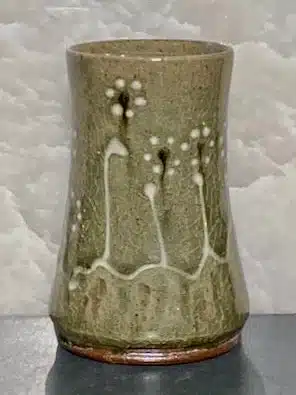
Tumbler, Mark Hewitt Pottery
Green celadon glaze tumbler with floral motif. White stems and white and black blossoms. Lovely variation in the color as you turn it in the light. Beautiful to the eye and the touch.
Dimensions: 5″H x 3.5″W
Antique Shows and Fairs
Major shows increasingly feature mid-century modern and studio pottery dealers. The Brimfield Antique Show, for example, has multiple dealers specializing in this category.
Plan your collecting around major shows—check our Brimfield Show Guide for dealer locations and specialties.
Expert Insight: A Dealer’s Perspective
We spoke with Sarah Mitchell, a Massachusetts-based dealer specializing in mid-century studio pottery, about the current market dynamics.
Journal: What’s driving the increased interest in studio pottery?
Mitchell: “I’m seeing two distinct buyer groups. First, established mid-century collectors who’ve been priced out of furniture are discovering pottery offers the same aesthetic at fraction of the cost. Second, younger collectors—millennials and Gen Z—who appreciate handmade objects and want investments that aren’t purely financial. They’re buying pieces they genuinely love, which creates authentic demand rather than speculation.”
Journal: What mistakes do new collectors make?
Mitchell: “The biggest mistake is buying unsigned pieces hoping for attribution later. Unless you have serious expertise, stick with documented artists. Also, people underestimate condition. A $200 perfect piece will appreciate faster than a $100 damaged piece. And finally, buy what you love—if the investment doesn’t pan out, you still have something beautiful.”
Journal: Where do you see the market in five years?
Mitchell: “Studio pottery will be fully integrated into the mid-century modern market. Right now, it’s still somewhat separate—pottery collectors versus furniture collectors. That distinction is disappearing. In five years, a Voulkos piece will be as expected in a mid-century interior as a Noguchi table. Prices will reflect that integration.”
Action Steps: Start Your Studio Pottery Collection Today
Ready to begin collecting investment-grade studio pottery? Here’s your strategic roadmap:
Month 1: Education Phase
• Visit museum collections (most major museums have ceramics galleries)
• Study maker’s marks using reference books and online databases
• Join pottery collectors’ clubs or online communities
• Set a budget and define your collecting focus (specific artists, regions, or periods)
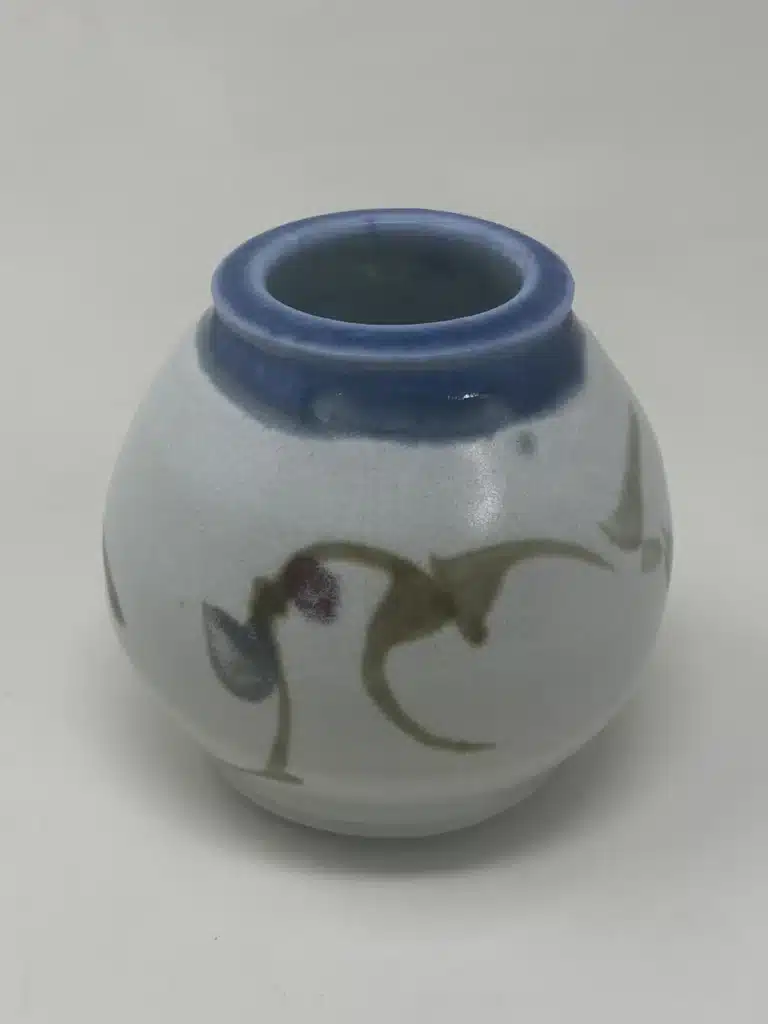
Cynthia Bringle, Miniature Vase, Porcelain with Brushwork, 3″
Month 2-3: Market Research
• Attend estate sales and auctions to see pieces in person
• Track completed auction sales to understand current pricing
• Visit dealers and ask questions (most are generous with knowledge)
• Start following studio pottery hashtags on Instagram for market trends
Month 4: First Acquisition
• Purchase your first piece—something documented, in good condition, within budget
• Photograph it thoroughly and document provenance
• Create a collection spreadsheet tracking purchase price, date, and source
• Display it in your home and live with it
Ongoing: Collection Building
• Acquire 2-4 pieces annually, focusing on quality over quantity
• Diversify across artists and periods to reduce risk
• Attend pottery workshops to understand the making process
• Consider selling pieces that no longer fit your focus to fund stronger acquisitions
Remember: The best collections are built slowly, with knowledge and passion guiding every acquisition. Studio pottery rewards patient, informed collectors who appreciate both aesthetic beauty and investment potential.
The Long View: Why Studio Pottery Matters
Beyond financial returns, collecting studio pottery connects you to a pivotal moment in American art history. The studio movement represented a philosophical stance—that handmade objects have value in an industrialized world, that craft and art exist on a continuum rather than in separate categories, that beauty and function can coexist.
These aren’t abstract concepts. They’re embedded in every piece you acquire. When you hold a Beatrice Wood bowl, you’re holding an object made by an artist who knew Marcel Duchamp and lived through the entire 20th century. When you display a Peter Voulkos student’s work, you’re acknowledging the revolutionary idea that clay could be sculptural material rather than merely functional.
The market is recognizing these connections. Museums are telling these stories. And collectors who understand the narrative—who can explain why their $500 pottery purchase matters culturally and historically—are the ones whose collections appreciate most significantly.
This is the first article in our Investment Intelligence series. Next quarter, we’ll explore vintage advertising displays and the nostalgia-driven market creating exceptional opportunities for informed collectors. Don’t miss it—subscribe to ensure you receive every installment.
Ready to start your studio pottery collection? Explore our Shop Finder directory to connect with dealers specializing in mid-century ceramics, or browse our glossary for terminology guides that will deepen your expertise.
Investment Intelligence is a quarterly series from Journal of Antiques & Collectibles examining emerging categories with strong appreciation potential. Our mission is to help collectors make informed decisions that combine aesthetic passion with financial wisdom.
About Investment Intelligence
Investment Intelligence is the Journal of Antiques & Collectibles’
guide to strategic collecting.
Each issue, we spotlight one antiques or collectibles category that shows:
– Documented price growth over multiple years
– Accessible entry points (often starting around $200)
– Strong fundamentals (scarcity, museum interest, active buyers)
This isn’t hype. It’s data-informed collecting backed by market research, dealer insights, and 25 years of editorial experience.
What You’ll Find in Each Guide
– Market snapshot: Why this category, why now
– Key makers, artists, or subcategories to watch
– Authentication and condition basics
– Where to buy: shows, dealers, and regional strategies
– A practical 90-day action plan to start or refine your collection
How to Read This Series
– Magazine Subscribers ($39.99/year)
Get each Investment Intelligence guide serialized over three issues of the Journal—perfect if you like to absorb information gradually and follow along month by month.
– Full Access Members ($64.99/year)
Get the entire guide at once, plus all magazine benefits, expert advice, DIY tutorials, restoration tips, and vintage lifestyle content—ideal if you want to move quickly on emerging opportunities.
A Note of Caution
Investment Intelligence is designed to inform your collecting, not guarantee financial returns. Markets move, trends shift, and every purchase still requires your own research, due diligence, and expert consultation when needed.
Have a Category in Mind?
We’re building this series with our community.
Send your ideas, questions, or collecting stories to editor@jaoc.online and tell us which category you’d like to see featured next.