
Norman Rockwell Museum Launches New Exhibition Series, A Brief History of Illustration, with Inaugural Installation The Abyss
Drawn from the Museum’s collection, the series illuminates illustration’s deep history
Stockbridge, Mass.– January 22, 2026 –Norman Rockwell Museum announces the debut of a new exhibition series, A Brief History of Illustration. The first rotation, titled The Abyss, is on view now through May 31, 2026. The Museum will present roughly two rotations each year, drawn exclusively from the permanent collection.
Designed to highlight both the rich history of illustration and the extraordinary depth of the Museum’s holdings—now numbering approximately 25,000 works of art—the Brief History of Illustration series will trace a single theme across time in each iteration. Each presentation will occupy one of the Museum’s galleries, offering visitors fresh encounters with rarely seen works and new perspectives on familiar images, while also providing an important context for the work of Norman Rockwell, America’s greatest illustrator.
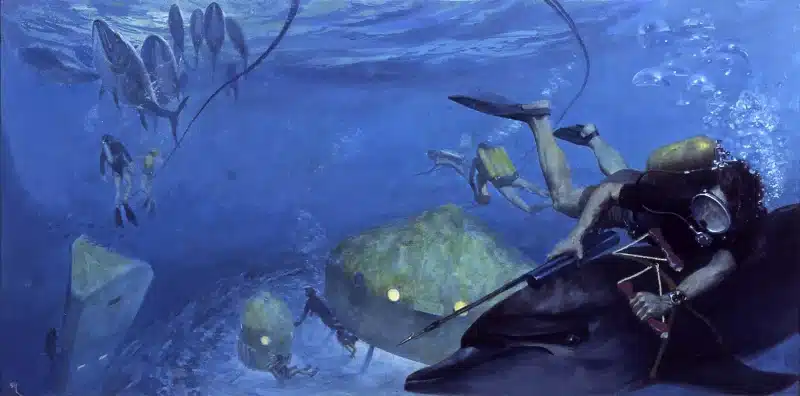
The Abyss explores a subject as visually compelling as it is symbolically complex: the ocean. From the 19th century to the present, illustrators have returned repeatedly to the sea as a site of beauty, mystery, danger, humor, and political meaning. The works gathered here reveal how images of the ocean have served many purposes—shaping wartime propaganda, anchoring political satire, conjuring fictional underwater worlds, and illustrating stories ranging from fairy tales to historical fiction.
“The word abyss has always described something unfathomable,” said Russell Lord, the Museum’s Chief of Curatorial Affairs, “But illustration attempts to illuminate that darkness. This exhibition brings together artists who used images of the sea to explain, question, warn, entertain, and imagine, revealing how illustration has helped audiences navigate both the known world and the imagined one.”
Spanning centuries and styles, The Abyss features work by some of the most influential illustrators in American and international visual culture, including Teresa Fasolino, Anton Otto Fischer, Joan Hall, Thea Kliros, Tom Lovell, Roy McKie, Stanley Meltzoff, Wendell Minor, Thomas Nast, Patrick Oliphant, Howard Pyle, and Norman Rockwell, alongside anonymous works and objects from the Museum’s archives.
Several artists in the exhibition envision fictional or speculative underwater worlds. Tom Lovell’s dramatic deep-sea scenes and Stanley Meltzoff’s fantastical Undersea Lab imagine the ocean as a realm of adventure, danger, and futuristic possibility. By contrast, other works respond directly to real historical events. Julian Allen’s haunting sketch of the sinking of the Titanic distills catastrophe into a few devastating lines, while Thomas Nast’s 1874 political cartoon, A Hard Fish to Catch, uses maritime metaphor to critique 19th-century American diplomacy. Patrick Oliphant’s Nixon at the Helm of a Sunken Ship extends this tradition into the 20th century, transforming the ocean into a stage for political reckoning.
Throughout the exhibition, the sea appears alternately serene and violent, whimsical and ominous. Roy McKie’s playful illustrations—best known for their association with Dr. Seuss—sit alongside the brooding romanticism of Thomas Fogarty’s storm-tossed vessel and the psychological intensity of Howard Pyle’s moonlit lake scene. Book illustrations, such as Thea Kliros’ Little Mermaid and Deb Koffman’s The Magic Lamp, demonstrate how even minimal gestures can suggest vast emotional and imaginative depths, while Norman Rockwell’s The Stay at Homes (Outward Bound) offers a poignant meditation on generations bound together by the lure of the sea.
Together, these works reveal not only the ocean’s symbolic power, but also the evolving role of illustration itself—from quickly executed sketches and journal covers to finely crafted paintings and iconic printed images. In doing so, The Abyss gestures toward a third, more metaphorical abyss: the Museum’s own ever-expanding collection. The exhibition offers a glimpse into those depths, underscoring the Museum’s ongoing commitment to bringing new light to the history of illustration and the artists who shaped public imagination.
Norman Rockwell Museum’s holdings include 865 original artworks by Rockwell, 25,000 original illustrations by almost 400 artists, and an archive of over 400,000 photographs, letters, and published materials. An actively acquiring institution, the Museum’s collections continue to grow through the generosity of artists and collectors. These new Brief History rotations offer an opportunity to highlight materials in the collection that have been rarely or never-before seen, as well as recent acquisitions demonstrating the Museum’s ongoing effort to trace a comprehensive history of the field of illustration. Unique in its mission, the Museum ensures the preservation, study, and interpretation of published imagery—the people’s art―which reflects and shapes perception and opinion across mass media. It also celebrates and shares the legacies of the many gifted creators who, working across time, history, and artistic styles, have shaped America’s visual culture in myriad ways.
A Brief History of Illustration: The Abyss is on view at the Norman Rockwell Museum through May 31, 2026.

About Norman Rockwell Museum
Norman Rockwell Museum illuminates the power of American illustration art to reflect and shape society, and advances the enduring values of kindness, respect, and social equity portrayed by Norman Rockwell. A comprehensive resource relating to Norman Rockwell and the art of illustration, American visual culture, and the role of published imagery in society, the Museum holds the world’s largest and most significant collection of art and archival materials relating to Rockwell’s life and work, while also preserving, interpreting, and exhibiting a growing collection of art by other American illustrators throughout history. The Museum engages diverse audiences through onsite and traveling exhibitions, as well as publications, arts, and humanities programs, including the Rockwell Center for American Visual Studies, and comprehensive online resources.
NRM is open year-round, six days a week; closed Wednesdays. Admission is charged, Free for Kids & Teens. For details, visit the Museum online at www.NRM.org.
Image Credits:
Tom Lovell, Billy Gohl Disposing a Body in the Wishkah River, 1955. Illustration for “The Case of Multiple Murder” by Joeseph Cloud and Alan Hynd, True, June 1955. Oil on canvas. Norman Rockwell Museum Collection, Gift of Robert T. Horvath. NRM.2011.14.01. ©Tom Lovell. All rights reserved.
Wendell Minor, Bucket of Rocks, 2005. Illustration for Buzz Aldrin: Reaching for the Moon (New York: Harper Collins, 2005). Gouache and watercolor on paper. Norman Rockwell Museum Collection, Gift of the artist, NRM.2021.05.128. ©Wendell Minor. All rights reserved.
Teresa Fasolino, The Prince and the Prosecutor, 1997. Oil on canvas board. Norman Rockwell Museum Collection, Gift of the artist, NRM.2018.16.12. ©Teresa Fasolino. All rights reserved.

Sponsored


