
Winnie the Pooh Turns 100
by Jessica Kosinski
There are a lot of cartoon bears out there, and I love them all. Long before I was a writer, I was a classic TV nut with a special interest in both sitcoms and cartoons. Growing up, I could easily list all the names, backgrounds, and key characteristics of everyone from Yogi and Boo-Boo to Paddington or the Gummi Bears. Heck, I even had some knowledge of the Hair Bear Bunch, who were a bit before my time. But one cartoon bear stood out from the rest, and that was thanks in large part to one of my favorite shows, The New Adventures of Winnie the Pooh. It ran from 1988 to 1991 originally, and I was completely hooked on it.

Vintage 13-inch Winnie the Pooh by Agnes Brush
I probably don’t have to tell you that Pooh Bear, as many of us affectionately call him, lived in the 100-Acre Wood, was the best friend of Christopher Robin, and had a whole crew of other friends, including Rabbit, Piglet, Owl, and Eeyore. However, you might not know a lot of other interesting things about the character, such as how he got his name. Let’s take a peek at the interesting history of the willy, nilly, silly old bear himself.
We’ll also peek at the many collectibles he and his 100-Acre Wood pals have spawned over the years.

produced by Beswick, many still classify these as ‘Royal Doulton’ collectibles.
Winnie the Pooh and His Many Birthdays
Winnie the Pooh as a franchise can trace its roots to the publication of the first book in 1926, which is why 2026 is widely considered Pooh’s 100th year. However, Winnie the Pooh himself has a few different birthdays, depending on your point of view. First, there’s Edward’s birthday. Edward was the bear owned by author and Pooh creator A. A. Milne’s son, Christopher Robin, in real life.
Edward was produced at Farnell’s toy factory along with many other bears in June 1921. Then A. A. Milne’s wife, Daphne, bought him at Harrods for their son, Christopher Robin Milne. Christopher’s parents gave him the bear on August 21, 1921. Edward became the partial inspiration for Winnie the Pooh, along with a real bear named Winnipeg and a swan named Pooh that Christopher loved when the family visited the zoo. However, that zoo visit didn’t happen until 1924, so that could be considered yet another birthday for Winnie the Pooh. As Pooh would say, “Oh, bother!”

Sponsored
Another important early birthday for Winnie the Pooh is the first time he appeared in a printed publication. It was in a story called The Wrong Sort of Bees. The story was published in a British paper called the Evening News just in time for Christmas in 1925.
Disney and Winnie the Pooh
It may seem like Winnie the Pooh already had enough birthdays, but he and his friends had another rebirth when Disney got involved in the early 1960s. Then, in 1966, with partial licensing rights, Disney released a short film called Winnie the Pooh and the Honey Tree. Many more Disney adventures featuring Winnie the Pooh and his friends have been released since, with no signs of stopping.
The important thing to know about Disney and the world’s favorite honey-loving bear is the company standardized his look and the looks of his friends. Many stuffed animals and other likenesses of Winnie the Pooh were made before the 1960s, but they were not the same as those we see today. That’s why Winnie the Pooh collectors often find themselves on one side of a line or the other. Either they collect pre-Disney Pooh items or post-Disney Pooh items. Granted, some do collect both.

Exceptionally rare 1936 Winnie the Pooh and Kanga character figures by Fulham Potteries.
The Centennial Shift in Collecting
Although I was born and raised in Massachusetts, I used to go to Disney World in Florida at least once per year as a kid because my aunt, uncle, and cousins lived there. It was our favorite vacation spot. One of my favorite things to do was collect my favorite Disney characters in stuffed-animal form. I spent years trying to complete my Pooh collection because I couldn’t find the right-sized Roo to go with the Kanga I had previously gotten. Eventually, I managed it, and it was an amazing day I’ll never forget.
The point of the above story is that I was an obsessive collector of Disney Winnie the Pooh stuffed animals, and many Winnie the Pooh lovers from my generation and younger generations are exactly the same – they love the Disney collectibles. However, the centennial anniversary of Winnie the Pooh is causing a bit of a collecting shift for some. It’s shining a spotlight on the earliest versions of the Pooh books, toys, games, and other merchandise released before Disney took over, much of which was produced in England.
E. H. Shepard’s Winnie the Pooh Legacy and Related Collectibles
E. H. Shepard was the illustrator who illustrated the first Winnie the Pooh books. Mr. Shepard also illustrated The Wind in the Willows. Many of his original ink drawings have been highly collectible for years. If any come up at auction this year, they might see even more bidding interest due to the centennial anniversary.

interior book illustration signed by the artist Ernest H. Shepard, 1928
He had a very distinctive style that clearly made his version of Winnie the Pooh stand out from the rest. It can be seen in the early books, sketches, and ink drawings. He also drew early maps of the 100-Acre Wood, which are definitely worth hunting for today.
One of the great things about collecting early Shepard drawings of Winnie the Pooh is they serve two purposes. They are collectibles, but as long as they are properly protected behind glass, they also make great decorations. Imagine decorating a nursery or playroom with them. That would be an excellent way to instill an early love of Winnie the Pooh in your child, not to mention an early love of antiques.
Pre-Disney Stuffed Animals
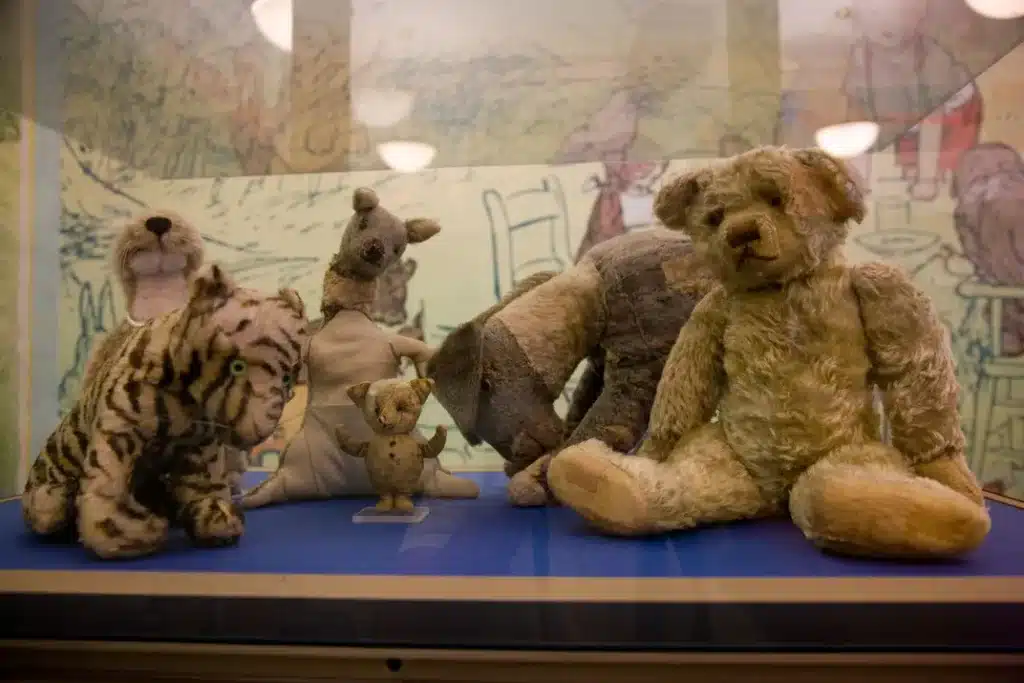
Among the most interesting Winnie the Pooh items you can collect are the early bears modeled after Edward the bear. Many were made in England, and they look nothing like the Disney version. They can be hard to spot, but finding one is like hitting the collecting jackpot. If you’re not sure how to spot early versions of the tubby little cubby all stuffed with fluff, there are plenty of collecting groups and reference websites that can help you. You can also start your education by checking out the collection of originals held by the New York Public Library.
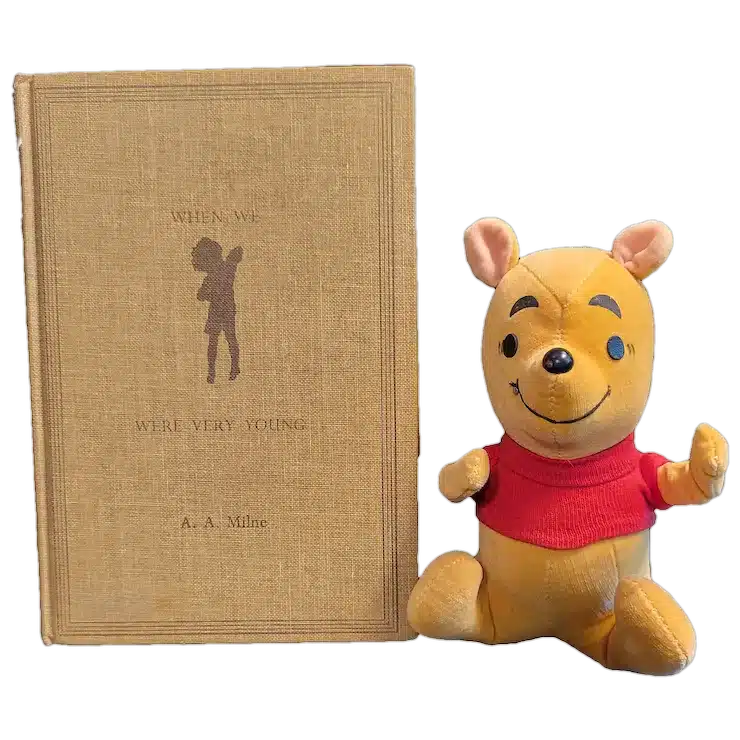
1964 Winnie The Pooh Gund Doll
with A. A. Milne Book When We Were Very Young
Early Disney Winnie the Pooh Collectibles
Of course, as mentioned earlier, there are those who prefer to collect the Disney version of Winnie the Pooh. If that’s more your speed, consider focusing on items produced by Disney from the 1960s through the 1980s. Those early items can definitely bring back a sense of nostalgia. After all, if you’re like me, you grew up with the early Disney versions of Pooh and his friends.
I’m partial to the stuffed animals myself, but the ceramic figurines, lunchboxes, records, and even animation cels can be great fun to collect.
The best thing about 1960s through 1980s Disney collectibles, something that doesn’t apply just to Winnie the Pooh and his pals, is that there were tons of them. Disney has always focused heavily on turning its cartoon characters into full-on brands by marketing merchandise featuring character images. From T-shirts to toasters, they do it all.
Winnie the Pooh Ceramics
Another interesting category, if you’re looking to collect items with a Winnie the Pooh theme, is ceramics. Earlier examples made in England usually had softer colors and featured the literary Pooh look. Many collectors view them as more refined and easier to fit into a space without dramatically changing a room’s appearance.

c.1928, printed with makers text, design numbers and numbers from the set. photo: Rosebery’s London

The Pooh Pantry Spice Jar Set by Lenox from the 2000s, showcasing the beloved character Winnie the Pooh from the Disney franchise.
You might also opt to collect ceramics depicting the cartoon versions of Winnie the Pooh and his pals. If so, there are lots of options. A quick search on eBay reveals everything from coffee mugs to serving platters, food storage containers, teapots, spice jars, and piggy banks, many of which remain reasonably priced and easy to find today.
An Unusual Word of Caution About Collecting
I’m proud to say I have been writing this column every month for over a decade now. If you’ve been reading it for a while, you know one of my favorite reminders is how much condition matters. Well, in this particular case, you can mostly ignore that advice.
Collectors of Winnie the Pooh memorabilia tend to be forgiving when it comes to minor condition issues. In fact, they often prefer a little wear. Well-loved condition can make stuffed animals, books, and other Pooh collectibles more attractive, because each one clearly has a story and a history.
How to Decide What to Collect
If you find yourself thinking “Oh, bother!” because you can’t decide what to collect, don’t overthink it. Just collect what you like. There are no rules. You can mix early and Disney-era items, focus on one character, or collect broadly. There is no wrong answer. Pooh himself is a simple bear who enjoys the simple pleasures in life. Keep that mentality when collecting, and trust your heart to point you in the right direction.
Jessica Kosinski has been a freelance researcher and writer since 2001. She developed a passion for pre-1990s television and films as a child and she has never grown out of it. Recently, she turned that passion into a retro TV and film blog. Follow along with her at https://medium.com/@jkos_writing, as she dives deep into the characters, actors, quirks, and trivia that brought us some of the greatest films and shows in TV history and also discusses some of the more obscure films and shows most of us may have forgotten.


